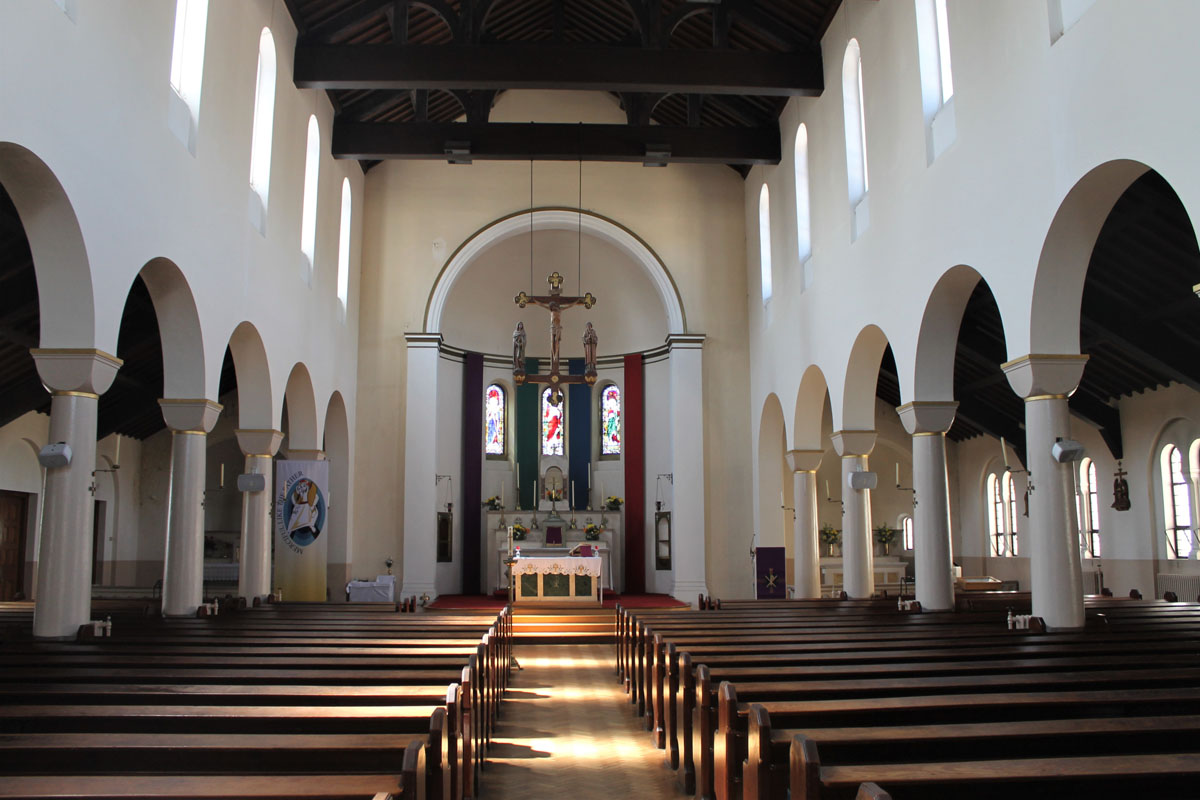
The Catholic story of Port Talbot and the Afan Valley is, at heart, a story about people — generations of faithful families who built something lasting out of very little. It begins in the mid-nineteenth century, when the industrialisation of South Wales drew thousands of Irish immigrants to the region in search of work. In 1849, a mission was established to serve this newly arrived and largely destitute Irish Catholic population in Aberavon. The priest appointed to the task was a Benedictine, Father Charles Kavanagh, who came from St David’s Priory in Swansea. In those early years the community had no building to call its own, and Mass was celebrated wherever space could be found. Various premises were used, including Capel Moriah, a Baptist chapel built in 1821, which was leased from 1852 to 1860.
Things began to take shape under Father Edward Glassbrook, who arrived in 1860. During his time, a church that also housed a school was built on the very site where St Joseph’s stands today, designed and constructed by a local man named John King — a member of the congregation himself. It was a wonderful example of a community quite literally building its own future. Father Glassbrook’s energy extended beyond Aberavon too. He went out and founded missions in the surrounding area, some of which grew into churches in their own right, including Our Lady and St Patrick’s in Maesteg.
The parish continued to flourish as Port Talbot’s steel and copper industries brought ever more people to the town. A separate school was built next to the church in 1870, and when Father Philip Kelly arrived as parish priest in 1905, he oversaw the construction of a large new presbytery in 1906, followed by a parish hall in 1928. By the 1930s the congregation had simply outgrown its Victorian home, and plans were made for a fine new church on the same Water Street site.
On 11 September 1930, the foundation stone was laid by Archbishop Francis Mostyn of Cardiff. The architect, Cyril Bates, designed a beautiful building in the Romanesque Revival style, complete with a striking campanile tower, apsidal chancel, and a nave with north and south aisles. The whole project cost £12,864, and on 29 October 1931 Archbishop Mostyn returned to formally open the church. Built in warm red brick beneath slate roofs, with round-headed windows and a bold triangular pediment, it remains a much-loved local landmark and is today a Grade II listed building.
The twentieth century also brought Catholic life further up the Afan Valley to Cwmavon. Canon Quilligan arrived at St Joseph’s in 1951, and by 1972 he had begun celebrating Mass in Cwmavon itself. A permanent home came about through a rather touching act of generosity. The minister of Salem Methodist Chapel, whose congregation had dwindled, approached Canon Quilligan himself — he didn’t want to see his beloved chapel of 1901 turned into a warehouse or a bingo hall, and so offered it to the Catholic community. The building was sold and opened as a Catholic church in 1974.
It was dedicated to St Philip Evans, a Jesuit missionary who had worked in South Wales and was among the Forty Martyrs of England and Wales canonised by Pope Paul VI in 1970. Born in Monmouth in 1645 and martyred in Cardiff in 1679, Philip Evans is a saint with deep Welsh roots — a wonderfully fitting patron for this valley community.
Today, St Philip Evans in Cwmavon and St Joseph’s in Port Talbot are served together as a single parish under the Archdiocese of Cardiff-Menevia. Their shared history, stretching back nearly 175 years, is a testament to the faith, resilience, and warm community spirit of generations of local Catholics.